It's a rainy afternoon, the kids are bored, and the printer pack you bought has the same twelve pages they've already colored twice. Or it's the night before a dinosaur birthday party and you can't find a single free printable that matches. This is where you make custom coloring pages with AI: instead of hunting the internet for a page that almost works, you describe what you want, or hand it a photo, and get a clean printable in seconds.
The AI coloring page generator is built for people who reach for coloring pages on short notice: parents, teachers, daycare staff, party hosts who need a themed page on demand. This guide covers both ways to make one, how to write a prompt that comes back as crisp line art, and how to print a page that holds up on ordinary paper.

Both paths land on the same result, a printable black-and-white line drawing on white. Pick based on what you already have.
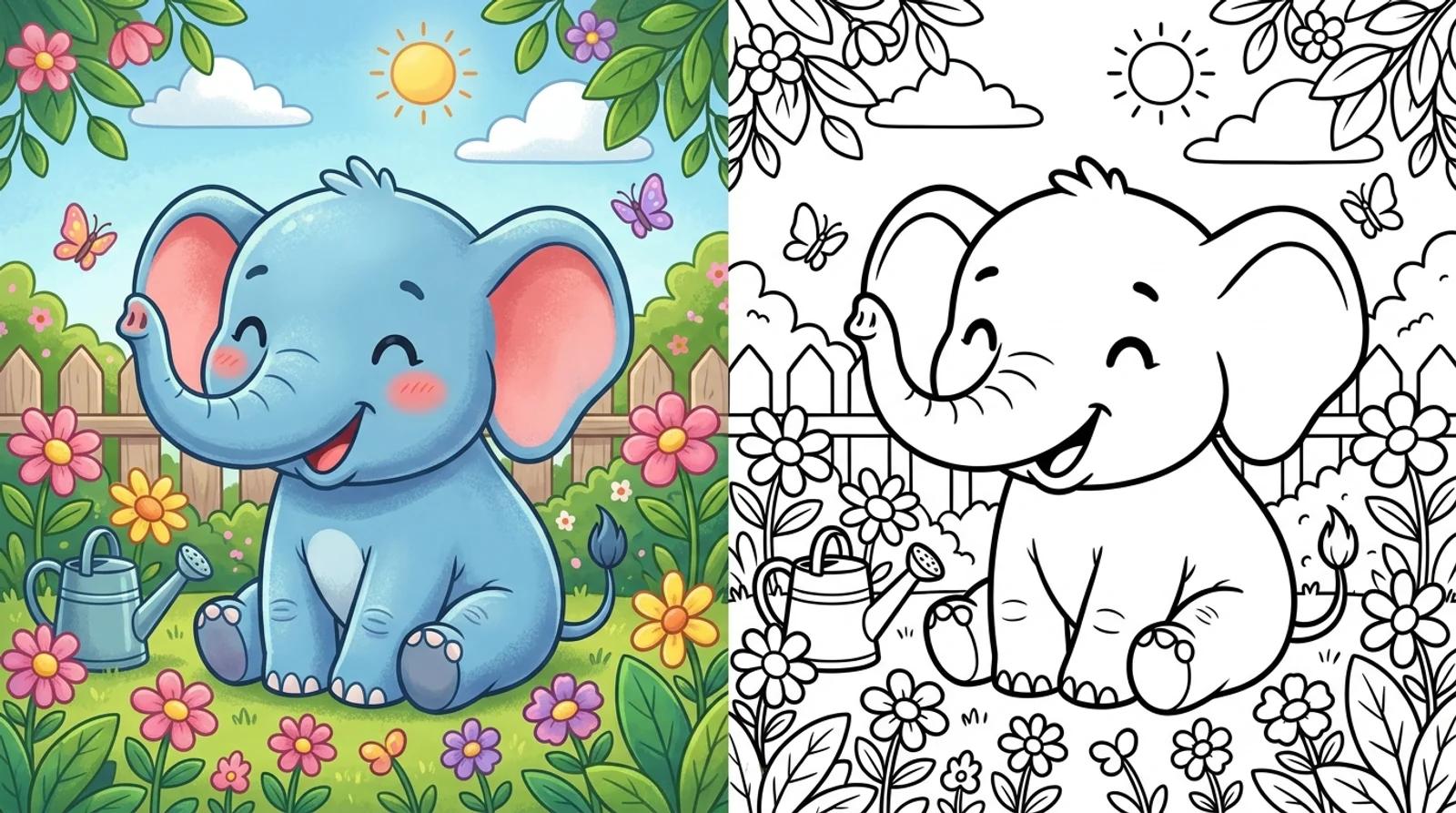
Start from a text prompt. If you know the subject but don't have a picture, describe it: "a friendly dinosaur in a jungle." The model draws it from scratch. This is the fast path for themed sets and anything imaginary.
Convert a photo or drawing. Upload a photo and it traces the subject into bold line art. This is where it gets personal: your own dog, the kid's favorite toy, a family snapshot, even a cartoon or anime character all turn into a page they can color. Pet photos, family photos, kids' own drawings, toys, cartoon characters, selfies, landmarks, and vehicles all work well as uploads.
Either way the output is line art for the child to color by hand. The AI makes the page; your kid brings the crayons.
A coloring page isn't a regular AI image. You don't want a finished, shaded illustration, you want an outline a child can fill in. Four things push a prompt toward clean line art:
- Name a single, clear subject. "A sea turtle" beats "an underwater ocean scene with lots of fish." One subject reads cleaner and is more satisfying to color.
- Ask for simple, bold outlines. "Bold outlines," "thick lines," and "coloring book style" steer the model toward color-friendly shapes.
- Match the detail to the age. Toddlers need big, open shapes. Older kids can handle finer patterns and busier scenes.
- Rule out shading. Add "no shading, no grey, black and white" so you get open areas instead of filled-in greys.
The tool appends the clean-output wording behind the scenes (bold black outlines, no shading, no grey, white background, printable, kid-friendly), so you can keep your part short and focused on the subject.
Two example prompts at different levels:
- Toddler (ages 2 to 4): "a happy baby elephant with big simple shapes and thick bold outlines"
- Older kid (ages 7 to 10): "a detailed rocket ship launching past planets and stars, fine lines, coloring book style"
Same tool, same flow. The only real difference is how much detail you ask for.
Open the AI coloring page generator. You have two options on the same screen: upload a photo to convert, or type a description. You don't have to do both. If you're converting, drag the photo in or click to select it.
Working from a prompt? Type your subject, "a friendly dinosaur in a jungle," and keep it to one clear subject. Converting? Upload your photo and let it trace. A sharp, well-lit photo with the subject standing out from the background gives the cleanest line art.
Click Make coloring page. The model draws your subject or traces your photo into a black-and-white line drawing on white. It takes a few seconds. When it finishes, you get a page ready to print and color.

Want a whole activity pack? Run several pages on the same theme with similar wording, a series of jungle animals or a set of vehicles, and you have a printable bundle for a party or a quiet afternoon.
A coloring page is only as good as the print. The output is built for it, black line art on white, so it prints sharp on standard home and classroom paper. A few settings keep it that way:
- Print at US Letter or A4. These are the sizes the page is designed for. Set your printer to "Fit to page" so nothing gets cropped.
- Leave a margin. A small white border gives little hands room to grip the paper and keeps the outline off the edge.
- Print in black and white. Pick "black and white" or "grayscale" in printer settings. It's faster, saves color ink, and the page is line art anyway.
- Use plain paper for crayons. Standard printer paper handles crayons and colored pencils fine. For markers that bleed, slightly heavier paper helps.

Bold outlines matter most. Thin, faint lines can wash out when printed, especially in draft mode, so a page with thick black outlines is the one that survives the printer.
The same tool works for a two-year-old and a ten-year-old. You just dial the detail up or down. Use this as a rough guide:
| Age group | Ideal complexity | Line thickness | Subject ideas |
|---|
| Toddlers (2 to 4) | Very simple, big open shapes | Thick, bold | Single animals, balloons, a favorite toy, basic shapes |
| Young kids (5 to 7) | A clear subject with a little background | Bold | Pets, dinosaurs, cars, cartoon characters |
| Older kids (8 to 10) | More detail and finer patterns | Medium | Rockets and space scenes, flower mandalas, vehicles |
| Tweens and up | Intricate patterns, dense detail | Fine | Mandalas, detailed animals, fantasy scenes |
When in doubt, go simpler. A busy page frustrates a young child, and an easy one gets more fun with a bigger box of crayons anyway.
Usually the first page comes back clean. When it doesn't, the fixes are quick:
- Ask for bold outlines. If the lines look thin, add "thick bold outlines" or "coloring book style" and run it again.
- Avoid grey and shading. If a page comes back with grey fills, regenerate it or start from a higher-contrast photo. A sharper source helps the model land on clean black outlines.
- Regenerate broken lines. If outlines look incomplete, run it once more. Each pass varies slightly, and the second try is often the clean one.
- Keep the subject simple. A single subject converts better than a cluttered scene. If a photo is busy, crop to the main subject first.
You're after open shapes with crisp black borders, the kind of page where a kid can stay inside the lines and the colors pop.
You can upload a photo or type a description and generate a printable coloring page on the free base model without an account. Signing in keeps your pages in history, so you can come back to a themed set, and it removes the export watermark from the download.
You don't have to settle for whatever printable turns up online. Describe the subject your kid is obsessed with this week, or upload a photo of the real thing, and get a clean printable page in seconds. Then hand over the crayons.
Try the free coloring page generator →